Idaho-based company will begin nonwovens production this fall.
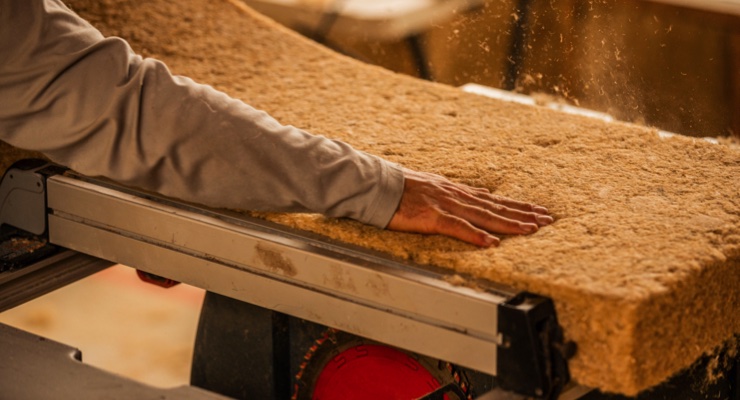
Hempitecture, a Ketchum, Idaho-based company, will soon be manufacturing a non-toxic, no-VOC and more sustainable thermal insulation product for residential and commercial buildings. Once complete, Hempitecture’s 33,000 sq. ft. nonwovens plant will be the first hemp insulation designated facility in the U.S.
The idea for Hempitecture came to Mattie Mead, CEO and founder, when he was an undergraduate in architecture and environmental sciences at Hobart and William Smith Colleges nearly a decade ago.
As a student, Mead became interested in a few challenges that he learned about in the built environment—one of which is that buildings and their operations are responsible for about 40% of our energy consumption and carbon footprint. Therefore, he began looking at ways that plant-based or rapidly renewable resources can be utilized to create more sustainable, environmentally-friendly buildings.
“The business as it was pitched in college is very different than it is today, and I didn’t even know or understand the term nonwovens when I was a student studying architecture,” Mead says. “We worked through a few different building products and concepts, and ultimately, we arrived at a natural fiber-based insulation product.”
Mead and his team learned about a hemp-based thermal insulation product being produced internationally, so they began importing the product and selling it to the U.S. market just before the start of the coronavirus pandemic. “We are already to market today with a comparable product, and after seeing the growth and demand for this product, we realized that we needed to establish a nonwovens facility here in the United States that can utilize an emerging supply chain for industrial hemp fiber and other bast fiber plants and commodities to create more sustainable insulation products.”
Hempitecture has partnered with Dell’Orco and Villani for its opening and blending line, and its high-loft airlay and thermobonding line is being furnished by Technoplants.