
CATAPULT Available in E-Book & Softcover
Two futures collide in this optimistic sci-fi mystery from breakout author Zev Paiss.
Danielle Woodson, a brilliant computer programmer, has created an AI powered program to solve the environmental challenges of urban living. In 2025, through a series of synchronistic events, she is offered the opportunity to implement her revolutionary program — until an unexpected event she may have been responsible for, irreversibly affects her future and all those close to her.
On a parallel future timeline in 2065, a wise female governor leads her city towards a sustainable future. In addition to her public service role, she desperately seeks to uncover an explosive and mysterious family history—
One that involves an internationally-renowned interstellar scientist on the verge of an historic discovery. . .
With a vetted vision of a protopian future where humanity is both healing and healer, CATAPULT (Book One of the From Here to There Series), is an engaging sci-fi mystery that offers more than just entertainment — it sparks genuine hope!

Zev Paiss, COO at Abraham Paiss and Associates, was recently interviewed by John Stewart for Let’s Hemp It addressing the current state of affairs in the industrial hemp industry. His no-nonsense remarks highlights the evolving state of hemp and includes several suggestion of how best to position new enterprises looking to capture market share.
Check out this link to see what he has to say.
Hempseed cake is a highly nutritious viable alternative feed source for cattle, a study by the U.S. Department of Agriculture (USDA) has found.

The study, which the USDA’s Agricultural Research Service carried out with researchers from North Dakota State University (NDSU), found that cattle fed hempseed cake, a byproduct of hempseed oil production, retained “very low levels” of the cannabinoids THC and CBD in muscle, liver, kidney and fat tissues, the farm agency said.
“From a food safety viewpoint, hempseed cake having low cannabinoid content can be a suitable source of crude protein and fiber in cattle feed while offering industrial hemp producers a potential market for this byproduct of hempseed oil extraction,” said David J. Smith, a NDSU research physiologist who led the study.
Source: Idaho News 6
JEROME, Idaho — Hempitecture became the first industrial hemp manufacturing plant in the U.S. on Feburary 17.
It is the first of its kind in America helping produce Hempitecture’s staple product HempWool, a new eco-friendly, sustainable housing insulation.
The opening marks the start of a new industry in southern Idaho that hopes to benefit the Magic Valley and the states economy as a whole.

Hemp is an ancient historical resource. It’s been used for thousands of years for fabric, building, various therapies, and as a stimulant. It was so much a part of the fittings in history that it didn’t really get much attention.
…Until the 20th century, when so-called moralists decided they didn’t like it. American folklore has it that J. Edgar Hoover didn’t like black people, discovered they used it, and then had it banned. (That is NOT a confirmed story, but who’d be surprised?)
Let’s not labor over the obvious. Three entire generations, maybe four, were introduced to a drug they could barely spell and the prohibition hysteria advertised the drug. Then organized crime, as usual, made a fortune simply because it was illegal. Great move, considering alcohol prohibition achieved exactly the same thing decades earlier. The result, of course, was mass production of hemp and cannabis.
Now it’s legal, and research is showing hemp is a massively valuable, easy to use, asset in so many ways it’s ridiculous. All very nice, you’d think, but the corporates are sniffing around. They seem to think anything that useful could be sold to someone so they can make money and prove they exist. Hemp is therefore getting a lot of attention on an hourly basis for its commercial applications.

Thankfully there is a bit of corporate-proofing built in to hemp. It CAN’T be an “exclusive resource” like oil. Hemp is incredibly easy to grow. Try and stop it. It grows just about anywhere, and in huge volumes. Its commercial applications dwarf most other materials.
We’ve now “discovered” all the old macro scale uses for hemp:
We could spend all day on just listing its uses. The fact is that hemp is so useful it’s indispensable. It’s also a much better and far cheaper cost option than many other materials.
Probable future uses include:
All of these things can be produced at a fraction of the cost of current materials. Hemp is also quite likely to have a second Renaissance as materials science duplicates its structures for other uses.
The likely outcome of the Hemp Revolution is a massive improvement of quality of life, whether anyone likes it or not. This sort of practical and monetary value can shout down even the most obsessive, prehistoric, morals.
…So there’s not much hype, and plenty of hope. Hemp can be grown in vast quantities. It’s effectively an inexhaustible resource.
Yet again, humanity is catching up with history and getting something right despite itself. Encouraging, isn’t it?
Read more: https://www.digitaljournal.com/tech-science/op-ed-hemp-hype-or-hope/article#ixzz7uABLjtJa
By Jean Lotus
A structural engineering study is in a third round of testing by a professor at the University of Nebraska-Lincoln to develop a hemp-based load-bearing masonry block. The new product has the potential to “greenify” the construction industry while also promoting a new agricultural crop for US farmers.

Marc Maguire, an assistant professor of civil engineering at U Nebraska-Lincoln’s Durham School of Architectural Engineering & Construction, has completed work on a prototype block, which will be manufactured by a local cement company in a trial run to undergo testing at the university before commercial manufacturing.
Funding Maguire is Nebraska-based hemp processing company Global Fiber Processing, which is sponsoring the research along with the Nebraska Department of Economic Development. The private-public project plans to commercially license the blocks to concrete block manufacturers, utilizing US-grown industrial hemp.
The finished block will be the equivalent of a concrete masonry unit (CMU), commonly known as a cinder block, Maguire told HempBuild Mag.
By Rosie Frost with AFP • Updated: 11/29/2022
The French Post Office is using pedal power to try and reduce its carbon emissions by 30 per cent before 2025.

Cargo bikes are just one innovative way La Poste is hoping to reach 100 per cent carbon-free deliveries in 22 French cities by this date.
By saddling up, postal workers are making sure packages and letters get where they need to go while cutting emissions.
“The aim for the Post Office group, in general, is to reach a 30 per cent reduction in CO2 emissions by 2025,” says Younes Lfara, La Poste’s director of urban logistics for the Ile-de-France region.
“So, with this objective in mind, we have planned for the acquisition of electric vehicles and cargo bikes.”
The Ile-de-France region already has 96 cargo bikes but it is aiming for 150. Across France, an estimated 1,000 of these cycles are needed to meet emissions reduction goals.
Riding them isn’t always easy. Nicolas Hildevert, a 27 year old postman from Paris, says that when you go from a car to a cargo bike “it’s quite complicated”.
Researchers in Texas have embarked on an ambitious project to develop hemp varieties for dual cropping of fiber and grain that can thrive in the state’s climate conditions. Ten to 20 varieties are expected to be developed by the beginning of 2024, and the goal is to release another 20-50 a year later, under a program at Texas A&M University.

The challenge is to develop cultivars that are heat and drought-stress tolerant and express less than 0.3% THC, the federal limit that defines industrial hemp from marijuana, according to Russ Jessup, a hemp breeding specialist in the Department of Soil and Crop Sciences at Texas A&M AgriLife Research, a part of the University’s Department of Soil and Crop Sciences.
“We’re trying to fill a gap that has not yet been served to the breeding programs in the southern U.S.,” Jessup said of the two-year research initiative that is developing the germplasm collection under a two-year grant from the National Institute of Food and Agriculture, a part of the U.S. Department of Agriculture.
“There’s been no breeding work on cannabis in Texas for more than 60 years because it was banned,” Jessup said, adding that the newly formed U.S. National Plant Germplasm System collection currently includes only a handful of industrial hemp varieties, none of which are fiber or grain types.
Hempitecture, a Ketchum, Idaho-based company, will soon be manufacturing a non-toxic, no-VOC and more sustainable thermal insulation product for residential and commercial buildings. Once complete, Hempitecture’s 33,000 sq. ft. nonwovens plant will be the first hemp insulation designated facility in the U.S.
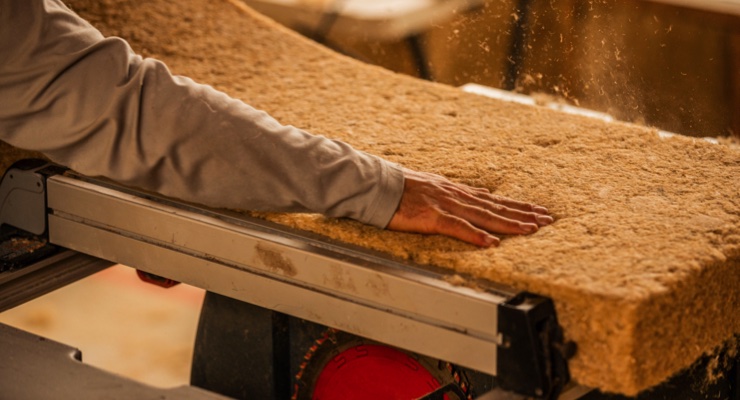
The idea for Hempitecture came to Mattie Mead, CEO and founder, when he was an undergraduate in architecture and environmental sciences at Hobart and William Smith Colleges nearly a decade ago.
As a student, Mead became interested in a few challenges that he learned about in the built environment—one of which is that buildings and their operations are responsible for about 40% of our energy consumption and carbon footprint. Therefore, he began looking at ways that plant-based or rapidly renewable resources can be utilized to create more sustainable, environmentally-friendly buildings.
“The business as it was pitched in college is very different than it is today, and I didn’t even know or understand the term nonwovens when I was a student studying architecture,” Mead says. “We worked through a few different building products and concepts, and ultimately, we arrived at a natural fiber-based insulation product.”
Mead and his team learned about a hemp-based thermal insulation product being produced internationally, so they began importing the product and selling it to the U.S. market just before the start of the coronavirus pandemic. “We are already to market today with a comparable product, and after seeing the growth and demand for this product, we realized that we needed to establish a nonwovens facility here in the United States that can utilize an emerging supply chain for industrial hemp fiber and other bast fiber plants and commodities to create more sustainable insulation products.”
Hempitecture has partnered with Dell’Orco and Villani for its opening and blending line, and its high-loft airlay and thermobonding line is being furnished by Technoplants.